
It was that unique sense of freedom you feel only when you are young and out on the sea.
Futureoftheocean:
The traditions of a place undoubtedly shape a young person, but I’m curious about your own experience. What was daily life like for you as a teenage and young adult Mariia? Which routines or moments from that period have stayed with you - the ones you still recall vividly today?
Ms. Klimova:
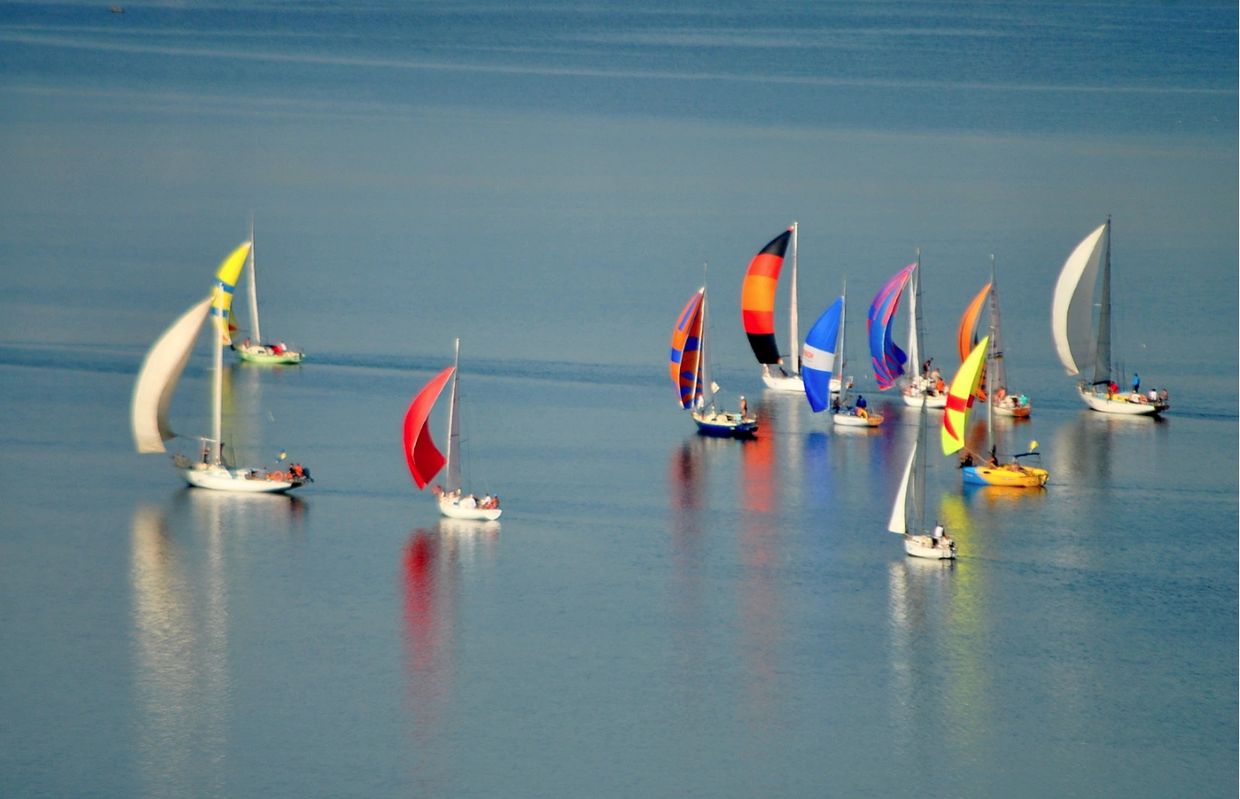
You know, growing up in Mykolaiv, the river simply cannot be just a backdrop. During my teenage years, I had a period where I was involved in sailing on the Southern Bug. It was a unique experience that actually began on the shore: as a sailor, you have to fully prepare your own boat. You realize that how well the entire yacht performs depends entirely on you and how you set it up. I still vividly remember that sense of responsibility - getting everything ready, then heading out onto the water to "read" the wind and understand the movement of the river waves. Those moments of tuning the sails and feeling the rhythm of the elements are among the most distinct memories of my youth.
When I looked at the initiative’s website and saw the interview photo with the Sea Cadets Bridge of Don - the two girls sailing a small boat with a single sail - I immediately recognized myself. I was always the one leaning far out of the boat, responsible for triggering the tack. The only problem, as my teammates used to joke, was that I was too light to make any impressive performance. But that didn’t matter to me. It was that unique sense of freedom you feel only when you are young and out on the sea.
That experience on the river naturally evolved into a deeper fascination with the vessels themselves. Quite often, I would visit my mother at her workplace. As I mentioned earlier, she worked in ship outfitting, just like I eventually did. Those visits sparked my curiosity about ships, I came to realize the uniqueness of a vessel as a complex ecosystem operating at the interface of two environments. Its hull must withstand the immense pressure of the water, while its superstructure faces the aggressive impact of the atmosphere. This duality makes the scale and complexity of a ship incomparable to any land-based machinery.
Everyone on my mother’s team worked on drawings that looked incredibly complex, and that complexity fascinated me. It felt intellectually exciting, almost like discovering a secret language. Those moments played a big role in shaping my interest in ships.
I don’t remember exactly when I first understood that those lines on the drawings represented systems- each one a part of the ship’s larger, integrated whole but that realization fascinated me. From that moment on, it became clear to me that every ship is like a small world of its own, autonomous for a certain period of time. And because of that, every vessel deserves our respect and admiration and taking part in bringing it into the world is an honour.
I never had any intention of leaving Mykolaiv, Ukraine. It was where I was born, where I studied, an
Futureoftheocean:
Fast‑forwarding through the story of your life, we arrive at a remarkable milestone: you were recently appointed Head of the Outfitting Department at the C-Job Nikolayev design office.
How would you describe the journey that led you to your current role?
Ms. Klimova:
I want to be very clear in saying that I never had any intention of leaving Mykolaiv, Ukraine. It was where I was born, where I studied, and where I built my career. My work provided me with true fulfillment and a wealth of fascinating experience; it truly opened up the world for me. Through my projects, I had the opportunity to visit the Damen shipyard in Galați, Romania, and go on business trips to the Netherlands, which allowed me to see the global scale of the industry firsthand. I had my own modest apartment, a life I loved, and I was surrounded by family and friends—even the project managers on my ships were close friends. Today, many of my colleagues and friends are working and living in Galați, and I think of them often. Everything was as it should be, and we were happy. The Russian invasion forced me to face a painful reality and leave my home to find a way forward. I moved to neighboring Poland, where for some time I worked at the Gdansk office of a global engineering firm. It was a vital step in continuing my professional journey during such a difficult time. Later, I received an offer to join the C‑Job Nikolayev team as they were establishing their new office in Gdansk. I have been part of this team almost since the very beginning of this branch, helping to build a new chapter while staying connected to my professional roots. Since joining, I have already had the opportunity to visit the Vard shipyard in Tulcea and the Vancouver shipyard, further expanding my international experience and expertise.
I always wanted to be a good engineer and to do my job as well as I possibly could.
Futureoftheocean:
I am sorry to hear that circumstances forced you to leave your hometown, yet I understand that-
much like a brig you managed to keep navigating the sea of life, driven forward by the mast of your profession when the mast of everyday normality had been damaged.
It seems you have caught a truly favourable wind astern with your recent career progression. Looking back, what were the key milestones that brought you to this point?
Ms. Klimova:
You may not believe me, but I never aimed for a managerial position. I always wanted to be a good engineer and to do my job as well as I possibly could. When this position was offered to me, I had serious doubts about whether I truly wanted to stop being an engineer and become a manager instead.
What helped me decide to accept this position was the fact that the rest of the management team assured me of their full support. I have known these people for some time, and I know how experienced and open‑minded they are, so being able to rely on their support means a great deal to me.

I believe it all comes down to mutual trust
Futureoftheocean:
Why do you think you were chosen to lead the outfitting department, and what moments along the way do you feel really shifted things for you - maybe a tipping point, or even a few of them?
Ms. Klimova:
I believe it all comes down to mutual trust - the team’s trust in the managers, and the managers’ trust in the team. Our managers strengthened our confidence that we truly contribute to the success of C‑Job Nikolayev as a design company, and that our voices and ideas matter. They showed this by inviting us to feedback and brainstorming sessions.
It quickly became clear that these meetings were not just a formality. There was a genuine effort to gather honest and accurate perspectives on how we work and how we function as a team. Another purpose of these regular meetings, initiated by the management team, was to generate fresh ideas about what we were doing and what we should be doing to improve our work and respond better to the needs of our clients and the market.
Now, as I try to answer your question and look back, I realize that I approached all these meetings with seriousness and always tried to do everything as well as I could. Perhaps these meetings were the very tipping points you were trying to identify -but in the end, it all came down to consistency, professional dedication, and a genuine desire to do things properly.
...whenever something is done well, it is always driven by passion
Futureoftheocean:
Consistency, professional dedication, and a genuine desire to do things properly are also what the Future of the Ocean team believes to be the essence of sustainable professional development - and this could be a beautiful closure for this interview.
Before we conclude, what message would you like to share with young people entering the maritime and offshore industry?
Ms. Klimova:
What I can say with certainty is that whenever something is done well, it is always driven by passion. Good engineering is simply not possible without passion.
In my case, my passion for shipbuilding came from the very DNA of my hometown. My city carried tradition, my family, my friends, the places where I learned to sail, and later the places where we built ships together. All of that shaped me and made this passion feel like something I was born into.
It is very important for everyone who chooses an engineering career to discover their own passion. And for those who have already reached professional maturity, it is equally important to help younger colleagues find their passion and follow the path of engineering.